




Aktuelles
Project Report of the Sino-German Urban Research Exchange Forum
As one of the tasks of the CDZNS, it is of great significance to promote high-level Sino-German joint urban research exchanges for the future international academic influence.
On 7-8 November 2025, the Sino-German Urban Research Exchange Forum, jointly organized by the Col-lege of Architecture and Urban Planning of Tongji University, the Sino-German Research Centre for Sus-tainable City (CDZNS), and the Humboldt Cities Network, was successfully held with the support of the BMBF, CDC, and DAAD.
Focusing on the two themes of ‘Urban Regeneration’ and ‘Urban-Rural linkages’, this event promotes dia-logues Humboldt scholars from China and abroad on cutting-edge urban issues, advance academic discus-sions and produce knowledge in urban studies. The experts discussed and shared case studies, methodol-ogies, and cutting-edge topics in Sino-German urban research, as well as the internationalization of aca-demic journals, and the future of in-ternational collaborative teaching, publishing, and research coopera-tion.
On the evening of 7 November, Dr. Matthias Bernt, acting head of the research focus Politics and Plan-ning at the Leibniz Institute for Research on Society and Space and adjunct lecturer at the Institute for Social Sciences at the Humboldt University in Berlin, was invited to give a keynote speech. In this presen-tation, Dr Bernt discussed the intertwined mechanisms of urban regeneration and housing policy, critical-ly reflecting on the common view that public policy is the main driver of gentrification. Through empirical studies of three urban communities in Lon-don, Berlin and St. Petersburg, he revealed the complex inter-actions between public policy and market forces, and called on academics to pay more attention to differ-ences in policy and local contexts when studying gentrification and urban regeneration, in order to more accurately un-derstand the mechanisms of social change in cities.
After the speech, there was a lively discussion on the role of the state, housing market regula-tion mecha-nism and social equity in urban regeneration. Dr. Bernt responded to the policy coordination and social impact of urban governance with the practical experience of major cit-ies in Europe, forming a good at-mosphere of academic interaction.
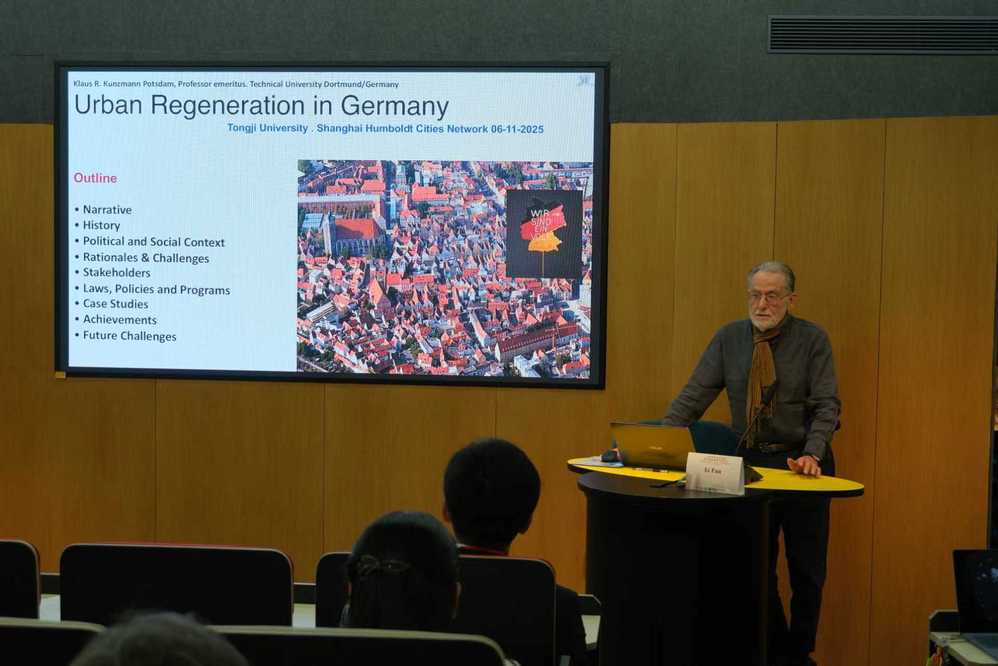
On 8 November, Prof. Klaus Kunzmann, renowned urban planner and founder and first Presi-dent of the AESOP, gave a keynote speech on the history, political and social background, chal-lenges, legal policies and projects, case studies and results of urban regeneration in Germany.
He mentioned that multiple factors have made urban regeneration a permanent task for local, regional and national governments in Germany. These factors include war damage, negligent maintenance by owners, material shortages, lack of funding, industrial transformation, new in-frastructure development, military facility renovation, functional changes, and even the gov-ernment's political support for the con-struction industry. The presentation provides a compre-hensive overview of German urban regeneration policy, describes its political, economic, social and legal background, analyses the participation mecha-nisms of property owners and citizens, analyses the roles of planners and conservationists, and explores the relationship between pub-lic and private actors in the regeneration process. It also demonstrates the effective results through selected town cases. Urban regeneration requires professional planning and manage-ment, knowledge of community life and work, flexibility and control, patience and time, a sense of social responsibility, respect for history and nature, willingness to communicate with people, and the ability to mediate between stakeholders.
The event has been publicized on the official public account of College of Architecture and Ur-ban Planning of Tongji University, and has a deep and extensive impact.